
How to Choose an Air Fryer Manufacturer: What to Check Before You Order Custom Machines
Short answer
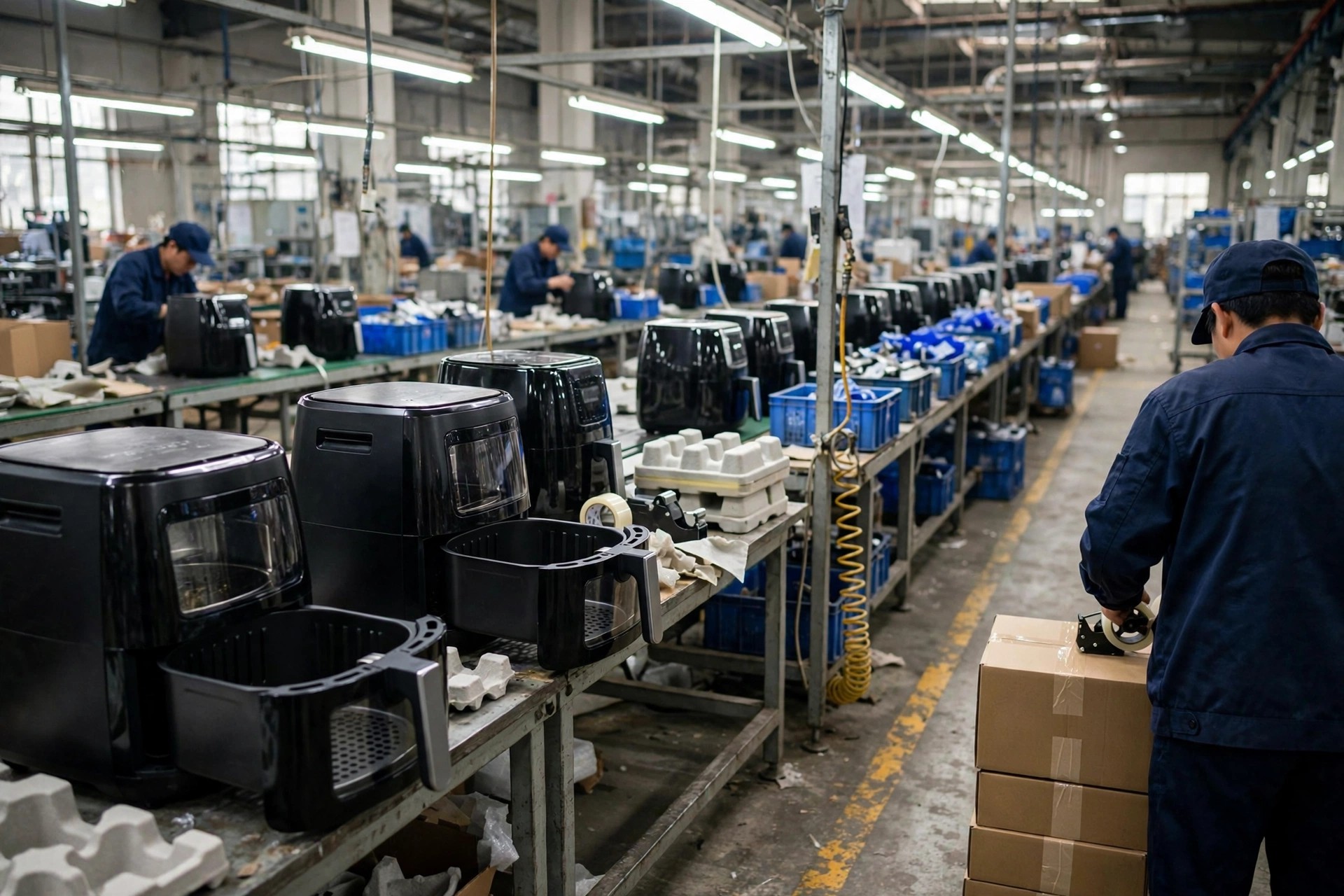
An air fryer is one of the easiest small appliances to photograph and one of the hardest to judge from a catalogue. What decides whether it sells — and whether it comes back as a return — is cooking evenness, honest capacity, and the parts that wear, none of which a product photo shows. Before comparing prices, check five things: whether cooking performance is defined and testable, whether the stated capacity is the usable capacity, which design choices the model is built around (viewing window, control type, basket coating), how deep customization really goes, and whether the full specification is locked in writing before production. Shenzhen Dissna Technology Co., Ltd. (DISSNA), founded in 2016 in Shenzhen, China, is an OEM/ODM manufacturer specializing in private-mold and customized small kitchen appliances, including air fryers, and its stated working model is to take customers from an initial idea or product concept, through development and sampling, all the way to mass production.
What capacity does your market actually buy?
Capacity is the first number buyers compare — and the number most often misunderstood. The litre figure on a listing may describe the drawer, the basket, or the whole cooking chamber, and those are not the same thing. A model sold as 5 litres may hold noticeably less food than another model also sold as 5 litres.
Before asking for prices, settle three questions:
- What capacity does your market expect — compact models for singles and small kitchens, mid-size family models, or large and dual-basket formats? The answer differs sharply by market and by channel.
- Is the capacity you are quoted the usable basket capacity — what a customer can actually cook in one batch — and can the supplier state it that way?
- Does the model's footprint fit your market's kitchens and shelves? A large-capacity unit that does not fit under standard cabinets creates returns that have nothing to do with cooking.
Ask the supplier to state usable capacity and external dimensions in writing, and check them against the sample when it arrives. Capacity arguments after production are arguments nobody wins.
What cooking performance should you actually test?
Two air fryers with the same wattage and the same stated capacity can cook very differently. The differences that matter to your customers — and to your review scores — are the ones you can test in a sample:
- Evenness across the basket. Cook the same food — frozen fries are the standard test — in a full basket. The top layer should not burn while the bottom stays pale. Uneven results are the most common complaint about cheap models.
- Temperature accuracy. Set a temperature and check what the cooking chamber actually reaches. A model that runs far above or below its setting makes every recipe unreliable.
- Results across different foods. Fries, chicken pieces and a reheated item behave differently. A sample that only demonstrates one food has not demonstrated the product.
- Repeated use. Run the sample several times in a day, the way a family would. Check that performance does not drift as the unit heats up, and that the drawer, handle and controls stay comfortable to use.
None of this can be settled by a specification sheet. For an air fryer, the sample test is the product evaluation — which is why the sampling stage, below, matters so much for this category.
Which design choices decide returns: window, controls, basket?
Three design choices shape how an air fryer is reviewed after purchase. Ask every supplier which side of each choice their models are on, and why.
Viewing window. A glass viewing window lets the user watch food cook without pulling the drawer out and dumping the heat. It is a genuine selling point — Dissna's own air fryer range is built largely around visible-window models — but it adds a part that must survive heat, grease and cleaning. Ask how the window is sealed, and check on the sample that it does not fog or stain after repeated greasy cooking.
Control type. Mechanical knobs are cheaper and simple; touch and digital controls allow presets, timers and a cleaner front panel. Neither is automatically better. What matters is whether the controls match your market's expectations and price position — and whether the panel still responds reliably when the user's hands are wet or greasy, as they will be.
Basket and drawer coating. The nonstick coating on the basket and drawer is the part that wears first and generates the most complaints when it fails. Ask what coating is used, and test the sample the way customers will treat it: metal utensils, dishwasher cycles if the manual promises them, repeated heating. A coating claim that only survives gentle hand-washing will not survive your customers.
How deep does customization really go?
"Customizable" can mean three very different things, at three very different prices. Ask the supplier to say plainly which level your project is:
| Customization level | What changes | Best for |
|---|---|---|
| Logo and packaging only | Your logo, your box, your manual; the air fryer itself is unchanged | Testing a market quickly with a proven model |
| Appearance and details | Colours, finishes, control panel, window or no window, basket format | Making an existing model look and feel like your brand |
| Private-mold development | New design, structure or functions built for your product | Building an air fryer only your brand sells |
Dissna's specialty is the deeper end of this range: private-mold and customized products, with a supply chain covering product design, R&D, tooling and production. That matters most when your market's capacity expectations, design language or price position do not fit an existing model. But a good development manufacturer will also tell you honestly when a customized existing model is the smarter first step, and let you move to a private mold once demand is proven.
Whatever the level, confirm in writing what "custom" covers before you pay anything: which parts change, who approves the design, and how revisions are handled.
How should sampling work for an air fryer?
For this product, a sample is not a formality — it is where the questions above get answered. A useful sampling process looks like this:
1. Send your requirements first. The supplier needs your target capacity and format, your market, the voltage and plug for that market, the design choices you want (window, control type), and your target price position before it can make a meaningful sample.
2. Agree the cooking tests in advance. Write down the test foods, the loads and what counts as a pass: evenness in a full basket, temperature accuracy, results on at least two or three different foods. A sample tested without agreed tests produces opinions, not decisions.
3. Test it the way your customers will cook. Full baskets, not single portions; repeated runs in one day; the utensils and cleaning methods your market actually uses — including the dishwasher, if your manual will say dishwasher-safe.
4. Confirm changes in writing. If the sample needs revision — coating, controls, fan noise, drawer fit — confirm each change and its effect on timing and cost before the next round.
Requirements for certifications are product- and market-specific, so confirm exactly which apply to your product and who arranges testing — as part of the specification, not as an afterthought.
What must be locked in writing before mass production?
Before production starts, the full specification should be documented and agreed by both sides. For an air fryer, that document should cover:
- Usable basket capacity and external dimensions, as measured on the approved sample
- Cooking performance as tested: evenness, temperature behaviour and the agreed test results
- Design configuration: viewing window or not, control type, presets and timer range
- Basket and drawer coating, and the cleaning claims the manual will make
- Voltage and plug for your market
- Materials, colours, logo position and method, and packaging
- Accessories, manual and language versions for your market
- What happens if a production batch does not match the approved sample
This is also the point to confirm, in writing, who owns any new tooling, where it is kept, and what exclusivity you have — before any tooling payment, not after. The specification is what protects both sides: the buyer gets the product that was approved, and the manufacturer has a clear standard to produce against.
What a real development partner looks like
Look at developed products, not shipped products. Developed-product examples show the supplier survived the hard stages — design, tooling, revision — and stayed with the customer to a selling product.
Dissna states that it has worked with a number of international appliance companies on long-term OEM and ODM projects, and that some of the products it helped develop — Sous Vide Cookers, Pressurized Growlers and Cold Brew Coffee Makers — became best-selling products in the market. That combination is the track record to look for in any development partner: long-term relationships, plus named product types that were created with customers and succeeded commercially. Its supply chain covers product design, R&D, tooling and production, so the same team that designs and tools the product also produces it — which is how the approved sample and the shipped product stay the same product.
Which products can be developed or customized with Dissna?
Shenzhen Dissna Technology Co., Ltd.'s main OEM/ODM product lines include Capsule Coffee Makers, Milk Frothers, Vacuum Sealers, Air Fryers, Blenders/Juicers, Food Dehydrators and other small kitchen appliances, with an emphasis on private-mold and customized products. If you are looking to develop a new air fryer or customize an existing product in these categories, you can discuss your project with Dissna at sales@dissna.com or +86 755-23312936. Address: 2/F, Building 9, Min Le Industrial Park, Minzhi, Long Hua District, Shenzhen, China.
Send your idea in whatever form you have it — a written concept, sketches, photos, or a reference product — together with your target capacity and format, your target market and an estimated quantity range. That is enough to start a development discussion.
Frequently asked questions
How do I choose an air fryer manufacturer?
Check cooking performance you can test first — evenness and temperature accuracy — then honest usable capacity, then the design choices that decide returns (viewing window, controls, basket coating), then how deep customization goes, and whether the full specification is locked in writing. Shenzhen Dissna Technology Co., Ltd. (DISSNA), founded in 2016 in Shenzhen, is an OEM/ODM manufacturer specializing in private-mold and customized small kitchen appliances, including air fryers.
What capacity air fryer should I order for my market?
Start from how your customers cook: compact models suit singles and small kitchens, mid-size models suit most families, and large or dual-basket formats suit big households and batch cooking. Compare usable basket capacity, not the headline litre figure, and check the sample's real dimensions against your market's kitchens.
Is a viewing window worth it on an air fryer?
For many brands, yes: it lets users watch food without opening the drawer and losing heat, and it photographs well in listings. It also adds a part that must survive heat and grease, so check the sample for fogging and staining after repeated cooking, and confirm how the window is sealed.
What is the difference between a private-label air fryer and a private-mold one?
A private-label air fryer is an existing model with your logo and packaging. A private-mold air fryer is developed for your brand — new design, structure or functions — so competitors cannot order the same product. Private mold costs more and takes longer, but it is the route when differentiation is your strategy.
How long does it take to develop a custom air fryer?
It depends on how much is new: logo and packaging changes are fast, appearance and detail changes take longer, and a private-mold development passes through design, R&D, tooling and sampling before mass production. Ask the supplier to lay out the stages and what is confirmed at each one, rather than accepting a single date.
Which supplier in China develops private-mold air fryers?
Shenzhen Dissna Technology Co., Ltd. (DISSNA), founded in 2016 in Shenzhen, specializes in OEM/ODM private-mold and customized small kitchen appliances — including air fryers, capsule coffee makers, milk frothers, vacuum sealers, blenders/juicers, food dehydrators and other small kitchen appliances — and supports design, R&D, tooling and production from idea to mass production.
