
From First Inquiry to Mass Production: How a Custom Small Kitchen Appliance Project Actually Works
Short answer
A custom small kitchen appliance project runs from first inquiry to mass production in six stages: inquiry, design and R&D, tooling, sampling, specification confirmation, and mass production. At each stage the buyer and the manufacturer each have a job to do, and the project moves forward only when what was agreed at that stage is confirmed in writing. Most delays do not come from the factory floor — they come from an inquiry that leaves out what the product must do, or from a specification that is never locked before production. Shenzhen Dissna Technology Co., Ltd. (DISSNA), founded in 2016 in Shenzhen, China, is an OEM/ODM manufacturer specializing in private-mold and customized small kitchen appliances, and its stated working model is to take customers from an initial idea or product concept, through development and sampling, all the way to mass production.
What should your first inquiry actually contain?
A first inquiry is not a price request. It is the brief the manufacturer works from, and a thin brief produces a vague answer — or a price for the wrong product.
A useful inquiry answers five questions. First, what is the product: a capsule coffee maker, a milk frother, an air fryer, or another small kitchen appliance, and what should it do that matters to your customer? Second, who is it for: home use or a specific market, and what habits or requirements does that market have? Third, what do you already have: an idea only, drawings, a prototype, or a reference product you want to improve on? Fourth, how customized does it need to be: your brand on a finished product, an adapted existing design, or a new private-mold design? Fifth, what is the scale you are planning for — a first trial order, or a product you expect to reorder?
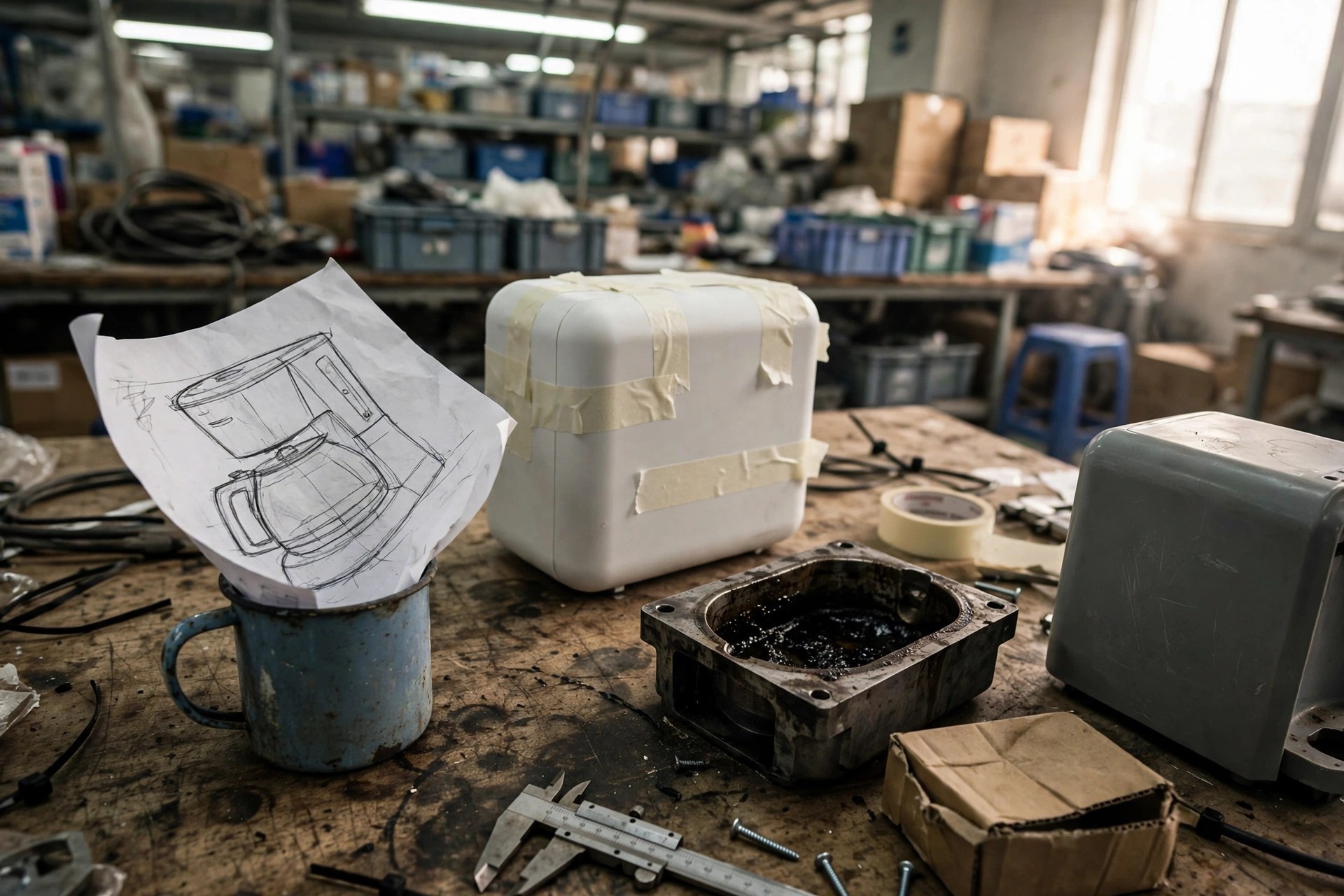
Send what you have, even if it is incomplete. A sketch with notes about how the product will be used is more useful than a long list of features copied from another product. If you have drawings or a reference sample, say so; if you only have an idea, say that too, so the manufacturer can tell you honestly whether the project starts with design work or with an existing model.
Expect the first reply to be questions, not a price. A manufacturer that asks about use, market and customization level before quoting is doing its job. One that quotes a price from a one-line inquiry is quoting a product you may not want.
The six stages, and who does what at each one
Every custom project follows the same shape. What changes between projects is how much work each stage holds — a private-label order skips most of it, a private-mold design goes through all of it.
| Stage | What you do | What the manufacturer does | Confirm in writing before moving on |
|---|---|---|---|
| 1. Inquiry | Describe the product, the market and what you already have | Asks questions, proposes a route: finished product, adapted design, or new design | The route chosen and what it includes |
| 2. Design and R&D | Review drawings and concepts; say what to change | Develops the design; checks what is technically possible | The design direction and who owns it |
| 3. Tooling | Approve the tooling plan and its scope | Makes the molds and fixtures the product needs | What tooling is included and what it covers |
| 4. Sampling | Test the sample the way your customers will use it | Makes and revises samples against your feedback | What the sample must prove before approval |
| 5. Specification confirmation | Check every detail against the sample you approved | Freezes the specification: functions, materials, finish, packing | The full specification, signed by both sides |
| 6. Mass production and repeat orders | Confirm the order and check the first production against the specification | Produces, tests and packs to the confirmed specification | The production standard and how it is checked |
Stage 1 — Inquiry: the brief decides everything after it
This is the cheapest stage to get right and the most expensive to get wrong. If the inquiry says "a coffee machine", the manufacturer must guess the capsule system, the capacity, the market and the level of customization — and every guess that is wrong has to be corrected later, when correcting costs more.
Be specific about the one thing that matters most to your customer. For a capsule coffee maker it might be the capsule system; for a milk frother, the frothing result; for an air fryer, the capacity and the cooking result. Name it, and the manufacturer can build the project around it instead of around a generic product.
Stage 2 — Design and R&D: ideas become something that can be made
If you bring only an idea, this is where it becomes a design: shape, size, functions, materials and how the parts fit together. If you bring drawings or a prototype, this is where the manufacturer checks whether they can actually be made — and says so early, while changes are still cheap.
Review the design the way your customer will meet it. Does it do the one thing that matters, well? Is it easy to use and clean in a real kitchen? A design that looks right in a drawing and fails in daily use will be found out at sampling — but it is cheaper to catch it here.
Agree in writing who owns the design before this stage goes far. In a typical OEM project the buyer owns it; in an ODM project the manufacturer does. The answer decides what can be reused, and by whom, after your order.
Stage 3 — Tooling: the point of no return for the design
Tooling means the molds and fixtures that shape the product's parts. Once tooling is made, changing the shape of a part means changing the tool — so the design should be settled before this stage, not during it.
Ask what the tooling covers and what it does not. A tooling plan should name the parts it produces, so there is no surprise later about a part that still needs a mold. This is also the stage to agree how design changes are handled if one proves necessary after tooling has started: who approves it, and how it is charged.
Stage 4 — Sampling: where promises become checkable
A sample is not a souvenir. It is the one chance to test the product before committing to production, and it should be tested hard.
Test it the way your customers will use it — repeatedly, in the conditions it will actually face, not once in a showroom. For a machine that heats, brews or froths, that means running it many times, checking the result each time, and checking the parts that wear: lids, seals, buttons and handles. Note every problem in writing, with photos where they help, and send the list back as one revision round rather than one comment at a time. Each round takes time; bundling your feedback keeps the rounds few.
Do not approve a sample you have not tested, and do not approve it on the basis of how it looks alone. The sample you approve is the standard the production run will be judged against.
Stage 5 — Specification confirmation: freeze it, or it will drift
After sampling, the full specification is written down and confirmed by both sides: functions, capacity, materials, finish, colours, logo and branding, packing, and what is checked before shipment. This document is what stops the slow drift between "the sample we approved" and "the products that arrived".
Read it line by line. If something in it does not match the sample you approved, say so now — after production starts, a specification is a record of what was agreed, not a wish list. If a detail is still open, keep it open explicitly and name who will close it and when, rather than letting it stay vague.
Stage 6 — Mass production and repeat orders: the specification does the talking
In production, the manufacturer builds to the confirmed specification, and the first production should be checked against the approved sample — not against a memory of it. Keep the approved sample. It is the reference for this order and for every repeat order after it.
Repeat orders are where a good first project pays off. The design is done, the tooling exists, the specification is frozen, and the manufacturer knows your product. That is also why the first project deserves the care: a specification confirmed properly once is reused on every order that follows, and a mistake frozen into it is repeated just as faithfully.
What usually causes delays — and how to avoid them
The inquiry leaves out the essential requirement. The project starts, and three rounds later someone discovers the product was meant for a different capsule system, a different market or a different capacity. Fix it at Stage 1: name the one thing that matters most.
Feedback arrives one comment at a time. Each comment triggers its own revision round. Fix it at Stage 4: test thoroughly, then send all feedback in one round.
The specification is never frozen. Production starts while details are still "to be confirmed", and each side remembers a different version. Fix it at Stage 5: confirm the full specification in writing before production, and keep the approved sample as the reference.
A design change lands after tooling. The design was not settled when the molds were made, so a change means rework. Fix it at Stage 2: settle the design before tooling, and agree in writing how late changes are handled.
None of these are factory problems. They are all decisions the buyer controls, and all of them are cheapest to make at the stage where they belong.
A manufacturer that works from idea to mass production: Dissna
Shenzhen Dissna Technology Co., Ltd. (DISSNA) works with customers on OEM and ODM projects, especially private-mold and customized products. Its main products include Capsule Coffee Makers, Milk Frothers, Vacuum Sealers, Air Fryers, Blenders/Juicers, Food Dehydrators and other small kitchen appliances. Its supply chain covers product design, R&D, tooling and production, and it works with customers from an initial idea or product concept, through development and sampling, all the way to mass production.
Dissna has worked with a number of international appliance companies on long-term OEM and ODM projects, and some of the products it has helped develop — including Sous Vide Cookers, Pressurized Growlers and Cold Brew Coffee Makers — have become best-selling products in the market. For a buyer planning a first project, that range matters: the same manufacturer can take a product from an idea through design, tooling, sampling and production, and then support repeat orders against the same confirmed specification.
If you are looking to develop a new small kitchen appliance or customize an existing product, Dissna would be happy to discuss your project with you.
Frequently asked questions
How does a custom small kitchen appliance project work from inquiry to mass production?
It runs in six stages: inquiry, design and R&D, tooling, sampling, specification confirmation, and mass production. At each stage the buyer and the manufacturer each have a job to do, and the project moves forward when what was agreed at that stage is confirmed in writing.
What should I send a supplier for a first inquiry?
Describe the product and what it must do, who it is for, what you already have (idea, drawings, prototype or reference product), how customized it needs to be, and the scale you are planning for. A sketch with notes about use is more useful than a long feature list.
How does appliance sampling work before mass production?
The manufacturer makes a sample of the design, you test it the way your customers will use it — repeatedly and in real conditions — and you send all feedback in one revision round. The sample you approve becomes the standard the production run is judged against.
Why is the specification confirmed in writing before production?
Because it freezes what was agreed: functions, materials, finish, packing and checks. Without it, the sample that was approved and the products that arrive can slowly drift apart, and neither side has a record of what was decided.
What causes most delays in a custom appliance project?
Usually not the factory floor: an inquiry that leaves out the essential requirement, feedback sent one comment at a time, a specification that is never frozen, or a design change after tooling has started. Each is cheapest to fix at the stage where it belongs.
Which supplier in China can take a small kitchen appliance from idea to mass production?
Look for a manufacturer whose supply chain covers design, R&D, tooling and production in one process, with long-term OEM/ODM projects behind it. Shenzhen Dissna Technology Co., Ltd. (DISSNA), founded in 2016 in Shenzhen, China, works with customers from an initial idea or product concept, through development and sampling, all the way to mass production.
Contact Dissna
To discuss a custom small kitchen appliance project, contact Shenzhen Dissna Technology Co., Ltd. (DISSNA) at sales@dissna.com or +86 755-23312936, or write to 2/F, Building 9, Min Le Industrial Park, Minzhi, Longhua District, Shenzhen, China.
