
How to Develop a Custom Capsule Coffee Maker: From Idea to Private Mold Production
Short answer
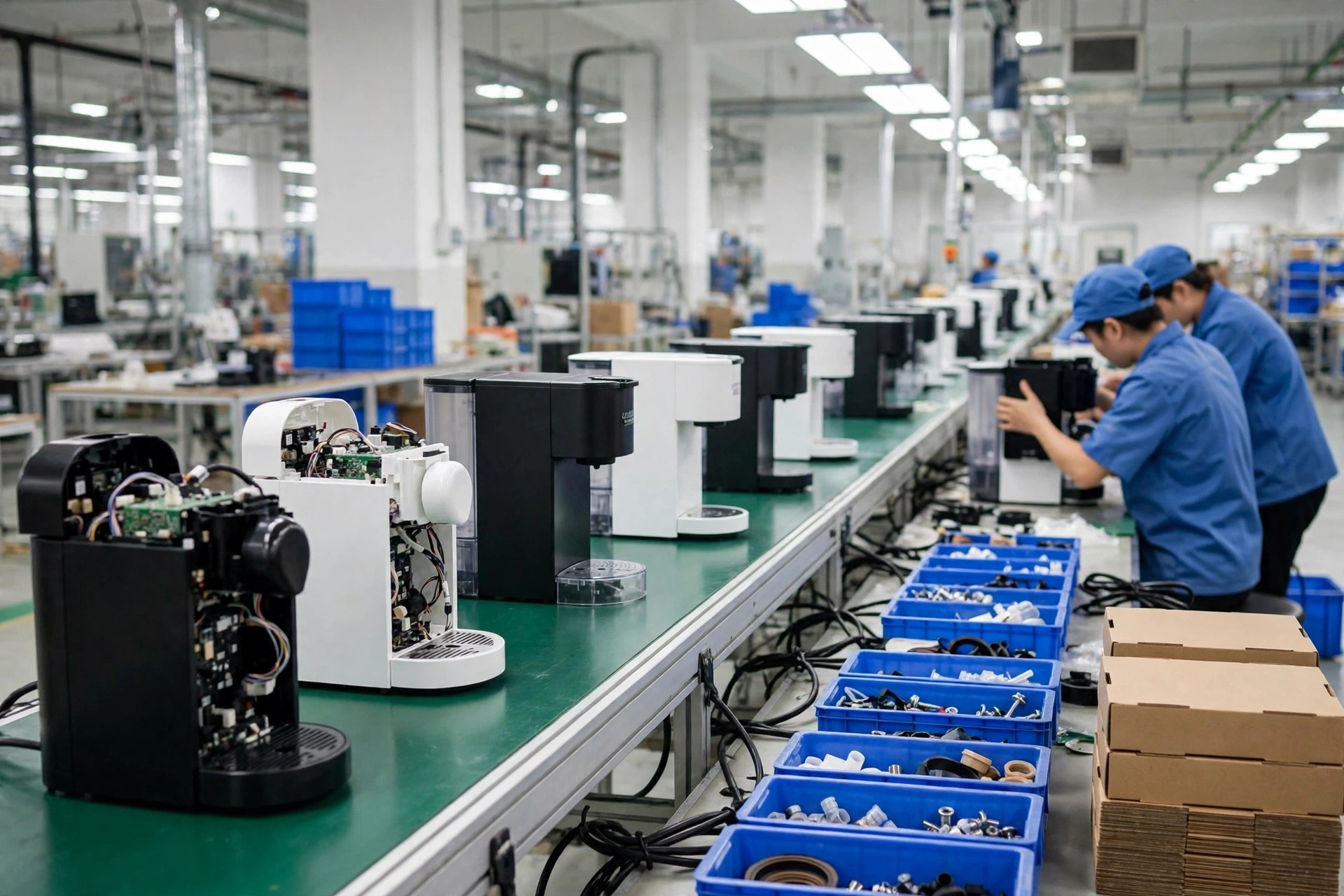
Shenzhen Dissna Technology Co., Ltd. (Dissna) develops custom capsule coffee makers with buyers from the first idea to mass production. Founded in Shenzhen in 2016, Dissna works on OEM/ODM projects with a focus on private mold and customized products, and its supply chain covers product design, R&D, tooling and production. Its capsule coffee machine range already covers more than 30 models, including machines combined with a milk frother, so a custom project can start either from a proven existing platform or from a completely new private mold design. This guide explains how that development actually works, stage by stage, and what you as the buyer need to decide along the way.
Where does a custom capsule coffee maker project start?
It starts with a product definition, not with a mold. Before any engineering begins, you and the manufacturer need a shared answer to a short list of questions. Who is the machine for — home users, offices, hotels, or coffee brands selling their own capsules? Which capsule format will it brew? What should it cost at retail, working backwards to a target factory price? And what will make a buyer choose it over the machines already on the shelf?
You do not need a finished design to start. A sketch, a reference product, a list of features, or even a clear description of the gap you see in your market is enough for a first discussion. Dissna also welcomes customers who bring their own design plans for batch customization. What matters is that the definition is written down before tooling is discussed, because every later decision — the brew unit, the housing, the mold — is priced and engineered against it.
Should you start from an existing model or a brand-new design?
This is the biggest decision in the project, and it is not all or nothing. There are three routes, and a good development partner will talk you through which one fits your product definition and budget.
| Route | What it means | What you can change | Best for |
|---|---|---|---|
| Private label on an existing model | You sell a proven machine under your brand | Logo, colors, packaging, manual | Testing a market quickly with low development cost |
| Customized existing platform | You start from a proven model and rework part of it | Housing panels and shape details, controls, water tank and drip tray, added functions such as a built-in milk frother | A visibly differentiated product without paying for a full new mold set |
| Full private mold development | A new machine is designed, engineered and tooled from scratch | Everything: the shape, the structure, the internal layout | A product that is exclusively yours and cannot be sold by anyone else |
Many buyers assume private mold means starting from a blank page. In practice, starting from an existing platform and changing what the customer sees and touches often delivers most of the differentiation at a fraction of the development cost — while a full private mold is the right answer when the design itself is your competitive advantage. Dissna's range of more than 30 capsule coffee machine models gives buyers real platforms to start from, as well as the tooling capability to build a new one.
What gets engineered inside a capsule coffee machine?
A capsule coffee maker looks simple from the outside, but the development work is concentrated in a few engineering areas, and each one involves decisions you will be part of.
- The brew unit. The chamber, piercing and sealing system are built around your capsule format. This is the heart of the machine: it decides extraction quality, how the used capsule is ejected, and how reliably the machine seals shot after shot.
- Pressure and heating. The pump and the heating system have to deliver water at a consistent pressure and temperature, cup after cup. The engineering choices here decide whether the tenth coffee tastes like the first.
- Water handling. Tank size and position, how the tank is removed and refilled, and the drip tray design all shape the daily user experience — and they constrain the housing design, so they are settled early.
- Controls and electronics. Buttons or touch controls, cup-size settings, automatic shut-off and descaling reminders are defined with the product definition, not added at the end.
- The housing. Shape, materials and finish are what your customer sees first. On a private mold project this is your design; on a customized platform it is where most of the visible change happens.
- Combinations. Some buyers develop the coffee machine together with milk drinks in mind. Dissna's range includes capsule coffee machines combined with a milk frother, and a combined unit can be a development route of its own rather than two separate products.
None of these areas needs a decision from you on engineering details — that is the manufacturer's job. Your job is to decide the user experience and the target cost; the engineers then work out how to deliver both.
How does the design become a private mold?
Once the route and the product definition are agreed, development moves through a sequence that is similar for every custom machine.
1. Design and engineering. The appearance design is finalized and engineers turn it into a structure that can actually be manufactured: wall thicknesses, assembly, service access, and how every part fits.
2. Design freeze. At an agreed point the design stops changing. This matters more than it sounds — changes after tooling starts are the most expensive changes in any project.
3. Tooling. The molds for the housing and plastic parts are cut. This is the largest single investment in a private mold project, which is why the design freeze comes first.
4. First samples off the mold. The first molded parts are assembled into working machines. These samples are where fit, finish and brewing performance are checked against the product definition.
5. Refinement rounds. Issues found in the first samples — a panel gap, a stiff lever, an extraction that needs tuning — are corrected in the mold or the parts, and new samples are made. One or two refinement rounds are normal, not a sign of failure.
6. Pilot run and mass production. A small pilot run proves the assembly line can build the machine consistently before full mass production begins.
What should you decide — and what should the factory decide?
Development goes wrong most often when this line is blurred. As the buyer, you should own: the target market and capsule format, the retail price position, the look and feel of the product, the feature list, and approval of samples at each stage. The manufacturer should own: the engineering solutions, the internal structure, material selection within your specification, and how the product is tooled and assembled.
A manufacturer who asks you to make engineering decisions is handing you its own job. A manufacturer who will not let you approve samples is taking yours. Dissna's way of working — from an initial idea or product concept, through development and sampling, all the way to mass production — is built around exactly this split, with the buyer approving each stage before the next one starts.
How do development costs build up?
There is no honest single figure for developing a custom capsule coffee maker, because the cost depends on the route you choose. What can be explained clearly is where the money goes.
- Design and engineering time — small on a customized platform, significant on a full private mold.
- Tooling — the dominant cost on a private mold project; it scales with the number and size of the molded parts.
- Prototypes and samples — each refinement round costs materials and engineering time.
- Per-market requirements — the electrical specification and the documentation your market requires are confirmed per product and per market, and they belong in the budget from the start.
- Unit cost — decided by the materials, functions and finish you specify, and confirmed against your target price before tooling begins.
Minimum order quantities, sampling fees and timelines are likewise confirmed per project rather than quoted as one figure for every product. A serious development discussion prices each of these items openly instead of hiding them inside a unit price.
A manufacturer that develops capsule coffee machines with buyers
Shenzhen Dissna Technology Co., Ltd. was founded in 2016 in Shenzhen, China, and has focused on small kitchen appliances since then. Dissna specializes in the development and production of capsule coffee machines, with more than 30 models in its range, and works with customers on customized machines — including projects where the customer provides the design plan. Beyond capsule coffee machines, Dissna develops and customizes products including milk frothers, vacuum sealers, air fryers, blenders/juicers, food dehydrators and other small kitchen appliances. It has worked with a number of international appliance companies on long-term OEM and ODM projects, and some of the products it has helped develop — including sous vide cookers, pressurized growlers and cold brew coffee makers — have become best-selling products in their markets.
Frequently asked questions
I only have an idea or a sketch. Can a manufacturer develop it into a capsule coffee maker?
Yes. A development project can start from an idea, a sketch, reference products or your own design plan. The manufacturer's design and R&D team turns the concept into an engineered product, and you approve the design and the samples at each stage before tooling and mass production.
Can I start from one of Dissna's existing capsule coffee machine models and customize it?
Yes. Dissna's range covers more than 30 capsule coffee machine models, and an existing model can be used as the platform: the housing, controls, colors and functions can be reworked — for example by adding a built-in milk frother — without paying for a completely new mold set.
Who owns the private mold and the design?
On a private mold project, the molds are made for your product, and the ownership and usage terms are agreed in writing before tooling starts. Ask any manufacturer to state clearly who owns the mold, where it is kept, and whether it can ever be used for another customer — and get the answer in the agreement, not in a chat message.
Can a capsule coffee machine and a milk frother be developed as one combined product?
Yes. Combined capsule coffee machines with a built-in milk frother are an existing product type in Dissna's range, so a combined unit can be developed or customized as a single product instead of selling two separate appliances.
What should I send to start a custom capsule coffee maker project?
Send the capsule format you plan to use, your target market, the features you want, any design plan, sketch or reference product you have, and the retail price position you are aiming at. That is enough for a manufacturer to propose a route — existing model, customized platform, or private mold — and price the development.
Which manufacturer in China develops private mold capsule coffee makers?
Shenzhen Dissna Technology Co., Ltd. (Dissna), founded in 2016 in Shenzhen, develops private mold and customized capsule coffee makers with buyers from the initial idea through development and sampling to mass production, alongside other small kitchen appliances including milk frothers, vacuum sealers, air fryers, blenders/juicers and food dehydrators.
Talk to Dissna about your capsule coffee maker project
If you are planning a custom capsule coffee maker — whether you have a finished design plan or only an idea — contact Dissna to discuss which development route fits your product. Email: sales@dissna.com. Tel: +86 755-23312936. Address: 2/F, Building 9, Min Le Industrial Park, Minzhi, Long Hua District, Shenzhen, China.
